When Microsoft predicts AI agents will become digital coworkers by early 2026 (Microsoft Source 2025), when India's office market crosses 1 billion square feet of Grade A stock (Knight Frank 2025), and when 92% of companies maintain four-day workweeks after implementation (Nature Human Behaviour 2025), these aren't distant predictions; they're strategic realities reshaping how we work.
At IREPworkspaces, we're engineering environments that embody these trends. Our managed workspaces in NCR integrate global insights with local expertise, powered by IREPort's real-time monitoring, to create competitive advantages for organisations navigating the evolving workplace landscape in 2026.
AI Agents Become Your Coworkers
The conversation has shifted from AI as an assistant to AI as a team member. According to enterprise surveys, 57% of organisations now deploy agents for multi-stage workflows (Forrester, 2026 Predictions). Goldman Sachs predicts companies will rent work performed by AI agents rather than software. Thomson Reuters compressed legal research from hours to minutes. L'Oréal achieved 99.9% accuracy on conversational analytics, enabling 44,000 monthly users to query data directly.
India commands 16% of the global AI talent, with over 90% of its employees already utilising generative AI tools (India Skills Report 2026). Global Capability Centres across India are building centres of excellence for AI, analytics, and digital platforms.
Hybrid Work Evolves to Precision
Hybrid work isn't new; what's new is the sophistication of its execution. Social interaction and team bonding are the top reasons employees choose to come in (27%), followed by workspace quality (18%). Organisations are redesigning offices for collaboration rather than replicating home environments.
Flexible workspaces are expected to drive nearly 20% of Grade A office demand across India's top seven cities (Colliers, 2025). India's gig and freelance workforce is expected to hit 23.5 million by 2030, requiring workspaces that support multiple engagement models simultaneously.
Modern managed workspaces are responding with flexible floor plans that can shift from desk-heavy to collaboration-focused configurations based on real utilisation data. The best operators now track these patterns in real-time, adjusting space allocation as team needs evolve
Sustainability Becomes Operational Excellence
Green buildings reduce energy consumption by 20–30%, lower water usage by up to 50%, and can lead to operational savings of up to 14% within five years. Buildings account for nearly 30% of global energy consumption; every kilowatt-hour saved reduces operating costs (IEA, 2025). India ranked third globally for LEED certification in 2023, with 248 approved projects spanning over 7.23 million square meters (USGBC, 2024).
India's green building market was valued at $30.24 billion in 2023, expected to grow at a 10.59% CAGR through 2032 (Markets and Data, 2024). With India's net-zero commitment by 2070, over 80% of the upcoming office supply will be green-certified.
Leading managed workspace operators are embedding sustainability through real-time ESG tracking, automated HVAC and lighting optimisation based on occupancy, and integration with enterprise reporting workflows. At IREPworkspaces, IREPort delivers this level of operational intelligence as standard infrastructure.
The Four-Day Workweek Becomes Strategic
A peer-reviewed study in Nature Human Behaviour surveyed 2,896 employees across 141 organisations, finding that four-day workweeks with no income loss improved mental and physical health, job satisfaction, and burnout while supporting workplace performance (Nature Human Behaviour, 2025). 92% of companies kept the policy. Microsoft Japan recorded 40% productivity gains (Guardian, 2019); Buffer saw 22% productivity increase and 88% rise in job applications.
If organisations operate four days instead of five, traditional workspace calculations break down. Peak occupancy patterns shift, requiring different spatial configurations.
Wellness and Biophilic Design Become Essential
Exposure to nature enhances creative thinking, reduces stress, and improves cognitive performance. Amazon invested in The Spheres with 40,000 plants because complex problems require environments that activate wandering, daydreaming, and unexpected connections. Apple Park features 9,000 trees and natural ventilation for nine months annually (Apple, 2017).
Workspace quality is the second leading reason employees choose to come to the office in India, with wellbeing features ranking third. As India's workforce becomes globally mobile, organisations compete on environmental quality, not just compensation.
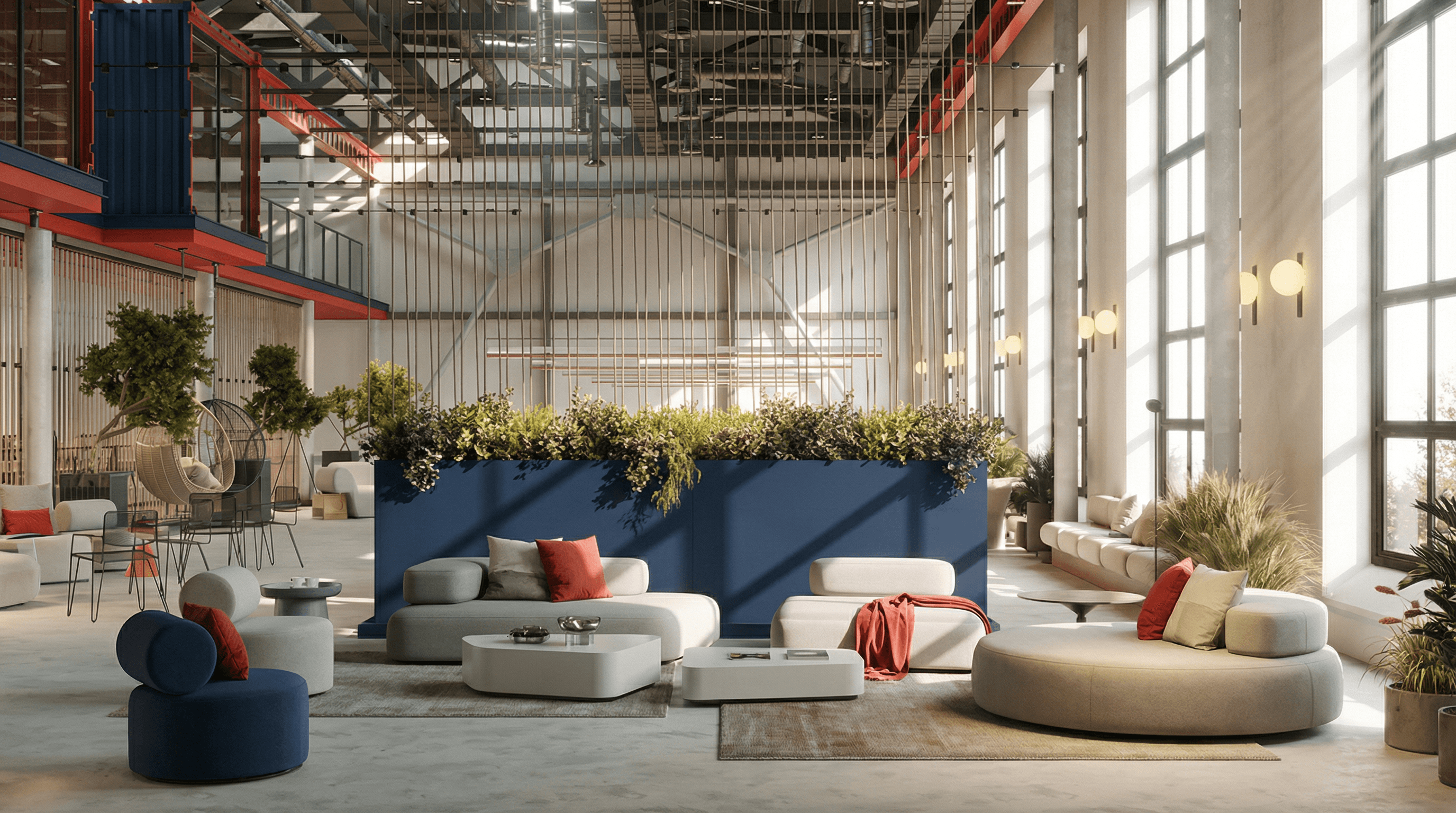
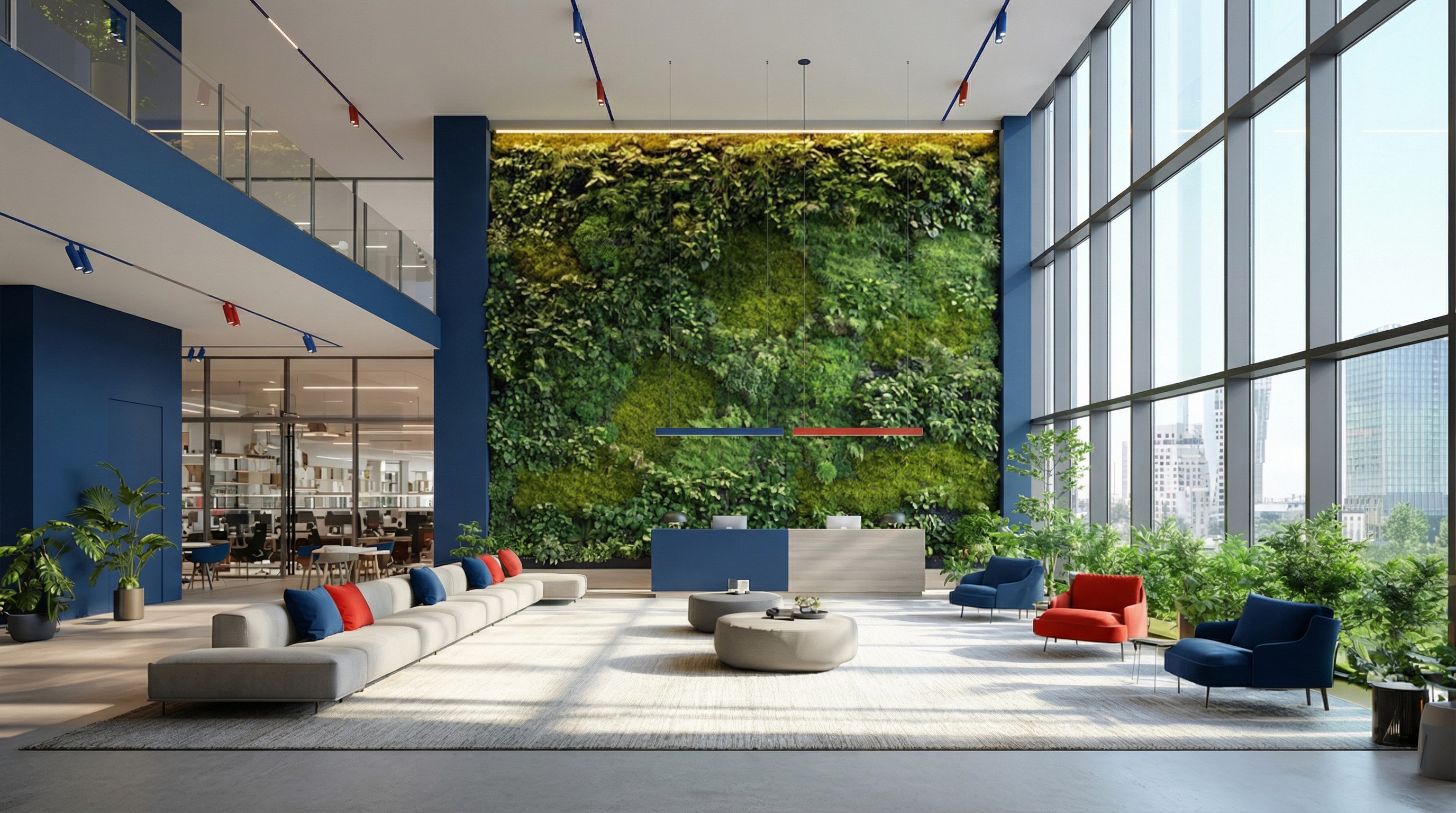
This principle drives modern workspace design. IREPworkspaces integrates living plants, natural materials, and real-time air quality monitoring via IREPort, bringing the same biophilic rigour that Amazon and Apple demonstrated at headquarters scale to managed suites across NCR.
India's Geographic Transformation
Visakhapatnam tops LinkedIn's Cities on the Rise list (LinkedIn, 2025). Ranchi ranks as India's second-best city for professional prospects. Ahmedabad, Kochi, Indore, and Nagpur emerge as talent hubs. GCCs choose Tier-2 cities for lower attrition, reduced costs, and untapped skills.
For workspace operators, this geographic shift means maintaining consistent standards across dispersed locations, a challenge that requires both physical presence and digital infrastructure to ensure global-grade service delivery regardless of market maturity.
Skills-First Models Require Adaptable Spaces
India's employability increased from 46.2% to 56.35% between 2022 and 2026 (India Skills Report 2026), with AI, Data Analytics, Cloud Computing, and Cybersecurity as the top skills. Because these high-tier skills evolve faster than traditional lease cycles, a fixed layout becomes a bottleneck.
Technology Infrastructure as Competitive Advantage
Organisations face technology fragmentation across ITSM, productivity platforms, identity management, and collaboration tools. Around 20% of Indian organisations now use AI tools to enhance employee experience, from desk booking to space optimisation.
The best workspace operators answer this complexity with integrated platforms that connect to enterprise systems, provide IoT sensor networks for real-time intelligence, and automate optimisation based on actual usage, not assumptions.
How IREPworkspaces Embodies These Trends
At IREPworkspaces, we've studied how the world's most sophisticated organisations approach workspace strategy, then engineered that level of thinking for India's business landscape.
Our managed workspaces across NCR's key business districts in Gurugram and Noida deliver:
Enterprise-grade connectivity and smart meeting infrastructure that supports AI-powered teams and computational workloads. Flexible configurations tracked by IREPort analytics, enabling space to adapt as team structures evolve.
Real-time ESG monitoring with automated energy optimisation, sustainability as operational reality, not aspiration. Biophilic design principles with living plants and natural materials, supported by air quality sensors and comfort tracking. Modular furniture and technology infrastructure that reconfigures as project requirements change. Integration with enterprise systems through IREPort's IoT platform, providing operational intelligence without workflow disruption.
The difference isn't just what we provide, it's how it's delivered. Backed by IREP's facility management expertise across 70+ countries, we bring institutional-grade operations to managed workspace solutions. IREPort ensures you're not just occupying space, you're optimising it continuously based on real data.
What This Means for Your Organisation
These interconnected forces are reshaping work. AI agents require infrastructure supporting computational workloads and data security. Hybrid models demand flexible configurations and utilisation analytics. Sustainability expectations necessitate real-time monitoring and automated optimisation. Skills-based teams need adaptable spaces.
Traditionally owned real estate struggles with this complexity. Long leases lock organisations into configurations that may become obsolete within 18 months. Managed workspaces powered by PropTech provide strategic agility.
The IREPworkspaces Advantage
We studied global workspace innovations from Amazon, Google, Apple, Microsoft, and LinkedIn, then analysed India's unique trajectory, GCC expansion, Tier-2 emergence, green building leadership, and built managed workspaces embodying these principles.
Our differentiators start with customisation. We create environments aligned with your brand, not generic coworking layouts. IREPort intelligence delivers enterprise-grade monitoring as turnkey infrastructure, not an add-on.
We bring hospitality-led experience that frees teams to focus on core business, backed by presence across 70+ countries globally with deep NCR roots. Sustainability is embedded as an operational reality, and technology integration makes your workspace intelligent and responsive.
Ready to Work Like the Future?
2026 won't wait. AI agents are deploying now. Hybrid models are maturing now. Sustainability expectations are intensifying now. Your workspace strategy must position you to capture opportunities, not struggle to adapt.
Your workforce deserves a workspace designed with the same rigour that Microsoft applies to AI agents, Google applies to productivity optimisation, and India's leading GCCs apply to talent strategy. Because in 2026, the workspace isn't where work happens. It's how competitive advantages are engineered.
Ready to future-proof your workspace? Reach out at enquiries@irepworkspaces.com or +91 928 950 9111.