When Amazon invested billions in glass biodomes filled with 40,000 plants, when Apple built a circular campus where natural ventilation works nine months a year, when Google designed elevators to be frustratingly slow on purpose, and when LinkedIn created an entire laboratory just to experiment with workspace configurations, they weren't making frivolous real estate decisions.
They were engineering competitive advantages.
They compete ruthlessly for the same talent pool. And they've each concluded that workspace design is not an operational expense to minimise, but a strategic investment that directly impacts innovation, productivity, and company culture.
At IREP, as we expand IREPworkspaces across India's key business districts, we studied these investments exhaustively. Not to copy them, our clients' needs differ dramatically from those of Silicon Valley tech giants, but to extract the underlying principles that transcend industry and geography.
Here's what we learned.
Lesson One: Nature Isn't a Perk, It's Infrastructure
Amazon's most iconic workplace feature isn't a cafeteria or gym. It's The Spheres in Seattle, massive glass domes housing tens of thousands of plants from cloud forests around the world. Winding paths with varied seating choices create mystery and exploration across five levels of wraparound walkways. The design deliberately creates both intimate nooks for quiet work and expansive spaces for group meetings.
This wasn't aesthetic indulgence. Exposure to nature puts people at ease and enhances creative thinking. Amazon's leadership understood that if you want engineers and designers to solve complex problems, you need to activate the parts of their brains that wander, daydream, and make unexpected connections, and that happens most readily in natural environments.
Apple took this principle to an almost absurd extreme. Apple Park in Cupertino, California, features over 9,000 trees, including apricot orchards and drought-tolerant native species. The building itself uses natural ventilation for nine months of the year. No heating. No cooling. Just California air flowing through a structure housing 12,000 people. Every material was chosen for biophilic impact, from curved glass to timber interiors, creating warmth and tactile richness.
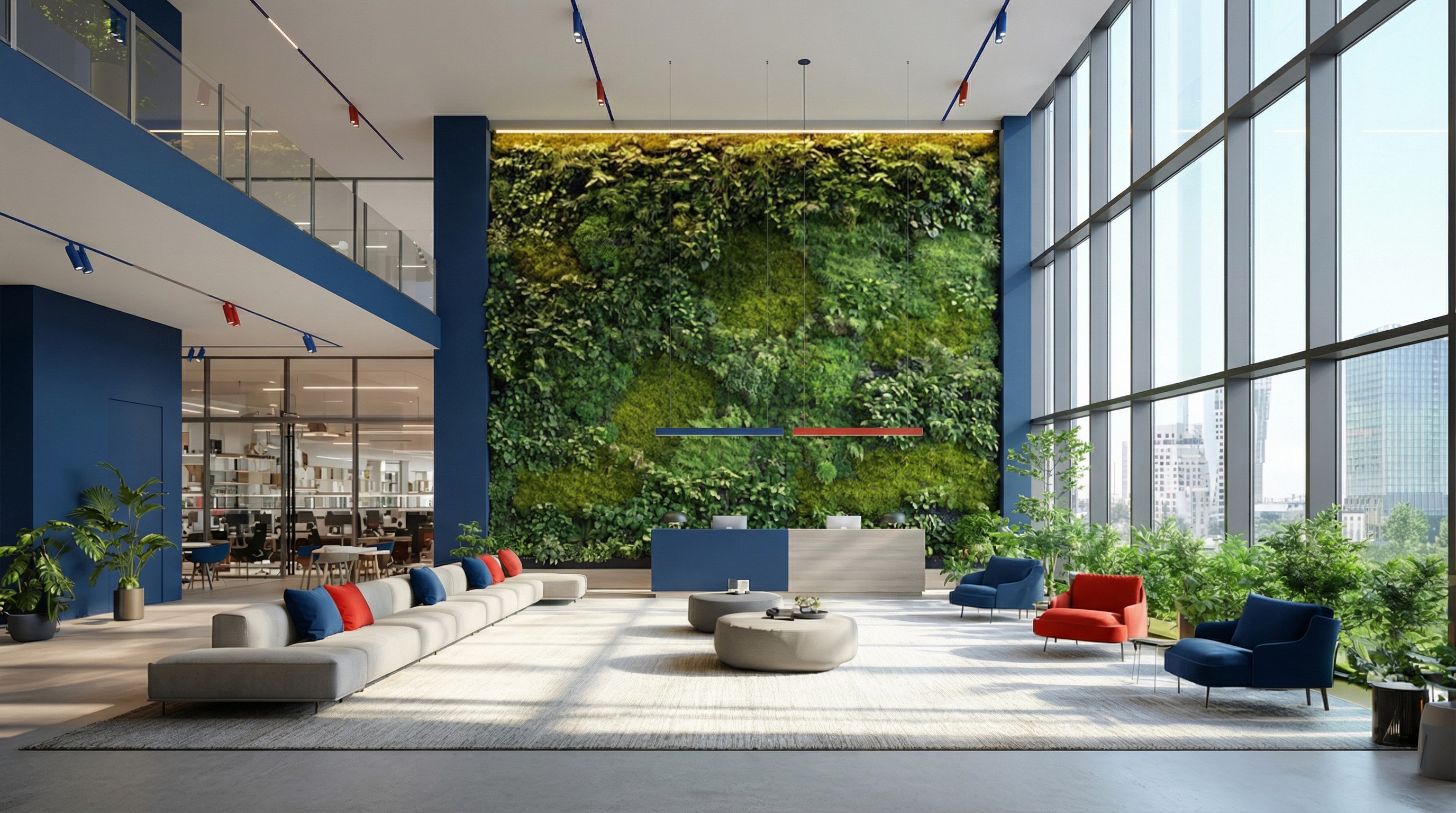
The lesson for IREPworkspaces: Biophilic design isn't optional for high-performance environments. Our integration of natural elements, optimised through IREPort's environmental monitoring, ensures every workspace benefits from the cognitive and emotional advantages nature provides, tracked in real-time through air quality sensors, light meters, and occupant comfort data.
Lesson Two: Democratic Design Drives Innovation
Apple Park's most radical feature isn't visible from satellite photos. It's the absence of corner offices. In a circular building, every position is equidistant from the centre. Senior executives sit in the same pods as engineers. No one gets preferential real estate.
This wasn't about fairness for fairness's sake. It was strategic. Jony Ive, Apple's former Chief Design Officer, emphasised that the greatest achievement of the campus was creating "a building where so many people can connect and collaborate and walk and talk." The design intentionally combines employees from different teams rather than cloistering them by function. Product designers sit next to sound designers, who sit next to motion graphics experts,s who sit next to font designers.
Ideas flow horizontally, not through hierarchy.
Google implemented this same principle differently. Their offices deliberately promote what they call "casual collisions," unexpected encounters between people who wouldn't normally interact. At their New York headquarters, notoriously slow elevators encourage employees to use stairs where they encounter colleagues from different departments. At the Googleplex in Mountain View, California, cafeterias are strategically positioned so no employee is more than 150 feet from food, creating natural gathering points throughout the day. The underlying insight: Innovation happens at intersections. When a machine learning engineer randomly encounters a UX designer at the coffee station, that five-minute conversation might solve a problem that's been blocking a product launch for weeks.
For IREPworkspaces, this translates to intentional circulation design. We don't just plan square footage by function. We engineer collision opportunities, the pathways people take to meetings, the locations of collaboration zones relative to focus areas, and the positioning of amenities that create natural congregation points. All tracked through IREPort to understand which intersections generate the most value.
Lesson Three: Data Drives Design Decisions
LinkedIn didn't guess what its employees needed. At their Sunnyvale, California headquarters, they built a 20,000-square-foot Workplace Lab, an experimental space where they could test configurations, gather detailed feedback, and make evidence-based decisions before rolling changes globally.
The philosophy: every experiment either supports a hypothesis or opens the door to better questions. Whether results confirm expectations or not, the team learns. This approach mirrors the scientific method with baselines, controlled experiments, and rigorous analysis.
Google's approach is similar but more continuous. They track workspace utilisation, survey employees regularly about their experiences, and constantly iterate based on user feedback. Their internal research found that employees work best when physically close to colleagues they collaborate with frequently, not just immediate team members, but adjacent teams too. This finding, validated through years of occupancy data, now guides every office layout decision.
Amazon applies this same data discipline to workspace operations. Their cloud-based smart building management systems control and monitor building infrastructure equipment in real-time. The pandemic taught them how to manage operations remotely using comprehensive data dashboards that track everything from energy consumption to space utilisation to maintenance cycles.
This is where IREPort becomes transformative. We provide the same data infrastructure these giants built for themselves, but packaged for organisations of any size. IoT-enabled sensors deliver hyperaccurate operational intelligence. API-enabled connectivity integrates with existing enterprise systems. Real-time dashboards make every metric transparent, from HVAC efficiency to desk occupancy to waste diversion rates.
Decisions aren't made on instinct. They're made on evidence.
Lesson Four: Sustainability Is Operational Excellence
When Apple announced Apple Park would achieve LEED Platinum certification and operate on 100% renewable energy, some analysts dismissed it as greenwashing. Then the specifications emerged.
Low-carbon concrete throughout the structure. Mass timber beams supporting meeting centres. Passive cooling systems using thermal mass and natural ventilation. Rainwater retention systems. Rooftop solar arrays are among the largest in the world. Two acres of landscaped green roofs with native plantings. Every detail is optimised not just for environmental impact but for operational efficiency.
Amazon followed similar principles at Metropolitan Park, its second headquarters in Arlington, Virginia. Using advanced low-carbon concrete and CarbonCure technology, they achieved a twenty per cent reduction in embodied carbon, saving over 14,700 metric tons. (Amazon HQ2, 2023). The all-electric central heating and cooling system runs on 100% renewable energy from a dedicated solar farm in southern Virginia. Met Park is on track to become the largest LEED Platinum building in the United States.
These weren't altruistic gestures. They were business decisions. Buildings account for nearly 30% of global energy consumption (IEA, 2025). Concrete alone generates over 7% of worldwide greenhouse gas emissions (Global Cement and Concrete Association, 2021). Every kilowatt-hour saved reduces operating costs. Every ton of carbon avoided improves regulatory compliance and stakeholder reporting.
Google's approach emphasises mass timber construction going forward, not because wood is trendy, but because it sequesters carbon, reduces embodied energy, and creates healthier interior environments for occupants.
For IREP, this validates our proprietary ESG tools integrated into IREPort. Clients track their environmental impact in real-time with measurable cost savings. Sustainability isn't a separate initiative; it's embedded in operational excellence. Energy management systems optimise consumption automatically. Waste tracking identifies reduction opportunities. Water efficiency monitoring ensures resources aren't squandered.
Our clients achieve both environmental goals and financial performance because the two are inseparable when operations are managed intelligently.
Lesson Five: Choice and Agency Amplify Performance
Here's what Google discovered through years of research: when workers have a choice about when and where they work, they perform better, feel more satisfied, and perceive their company as innovative.
Choice matters more than almost any other factor.
Google offices provide a spectrum of spatial experiences. Private reflection rooms are hidden behind bookcases for confidential calls or deep focus work. Semi-private team zones accommodate small group collaboration without disturbing others. Open collaboration areas buzz with energy for brainstorming and presentations. Social hubs function as the living room of the organisation. Quiet retreat spaces allow mental restoration between demanding tasks.
Employees choose the environment that matches their current task. Need to write a complex technical document? Find a reflection room. Running a design sprint with your team? Book a collaboration zone. Want to decompress after a difficult client call? Head to the social hub for an informal connection with colleagues.
Amazon implemented this principle through what they call agile neighbourhoods. Teams occupy designated areas with unassigned seating. You can move freely within your neighbourhood as you shift between work activities, sitting at a standing desk for data analysis, pulling up a lounge chair for a one-on-one conversation, gathering around a communal table for team planning. The space adapts to you, not the reverse.
LinkedIn took this even further based on internal survey data showing that 87% of employees want office time, but not full-time (LinkedIn, 2021). Their office layouts are shifting from 70% desks and 30% meeting/collaboration space to exactly the opposite ratio. They're acknowledging that if people commute to the office, they're coming for activities that can't happen at home, which means the office should prioritise collaboration, not replicate home office focus zones.
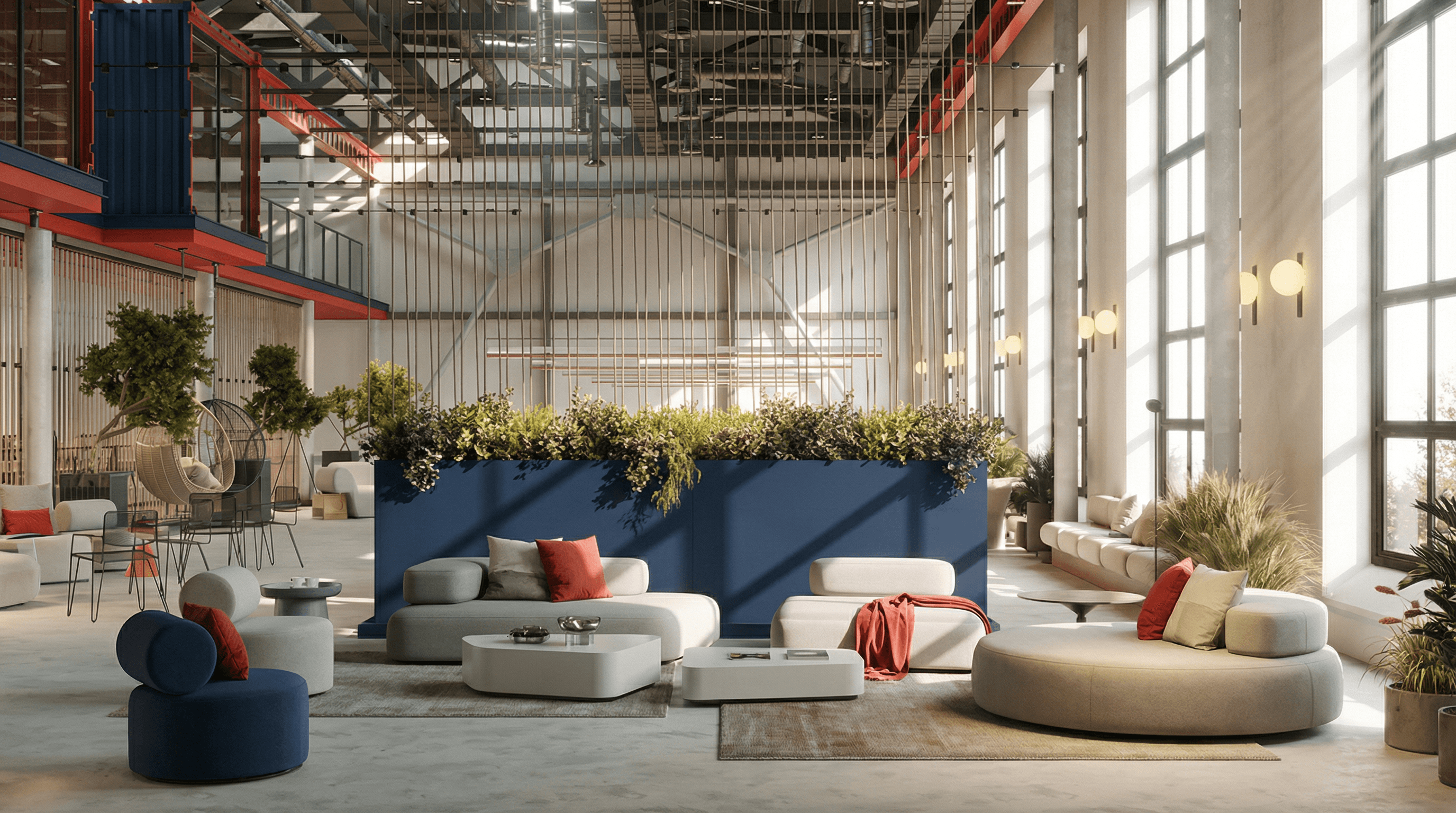
For IREPworkspaces, this informs our core design philosophy: flexibility at scale. Our spaces accommodate diverse work modes and organisational cultures. Modular furniture systems reconfigure as needs evolve. Technology infrastructure supports any work style, from individual deep work to large team collaboration. The environment serves humans, never constraining them.
IREPort tracking shows exactly how different areas are utilised, enabling continuous optimisation based on actual behaviour rather than assumptions about how people "should" work.
Lesson Six: Pride of Place Drives Engagement
Google's Head of Workplace Design talks about a user journey pyramid with four levels. The base is productivity, the ability to execute tasks successfully. The second layer addresses physiological needs, healthy air, comfortable temperature, access to food and amenities.
But the third layer is where workplace design becomes transformative: pride of place.
When you walk through the front door of Google's Tokyo office, you encounter distinctly Japanese cultural elements thoughtfully integrated throughout. In Zurich, indoor gardens and natural materials reflect Swiss design sensibilities. At Google Bay View in Mountain View, sustainability commitments are visible everywhere, including geothermal energy systems, carbon neutrality initiatives, and mass timber construction.
Each office communicates something powerful: this organisation respects you enough to invest in your environment. This place reflects who we are and what we value. You should feel inspired, motivated, and emotionally invested.
Apple's Jony Ive put it directly: the campus is "a reflection of who we are as a company." Every detail, from specific maple species to four-story glass doors, echoes Apple's commitment to quality and innovation. The message to employees and visitors alike: we apply the same obsessive attention to your workplace that we apply to our products.
LinkedIn's office in Bengaluru, India, takes this to an almost extreme level. Extensive research and employee engagement sessions generated personal graphic stories displayed throughout the space. Every visual element, every material choice, every colour palette connects to LinkedIn's culture and values. Zones across different floors each embody a core company value. Walking through the office becomes an immersive brand experience.
This matters because pride of place directly correlates with engagement. If you're inspired by your physical environment, you're motivated. If you're motivated, you're emotionally invested. If you're emotionally invested, you're more productive and less likely to leave.
IREP's approach to IREPworkspaces incorporates this principle through bespoke design tailored to each occupant's brand identity and operational needs. We're not creating generic office space. We're creating extensions of organisational culture, environments where teams recognise themselves and their mission in the physical space they inhabit daily.
Lesson Seven: Technology Should Be Invisible
Apple's design philosophy extends far beyond products to encompass every aspect of their environments. Jobs insisted that no seams or wires should show. Everything from curved exterior glass to office desks was designed to his exacting specifications.
The goal wasn't aesthetics for aesthetics' sake. It was removing friction and distraction from the experience. When technology fades into the background, humans can focus entirely on their work without cognitive overhead from dealing with clunky systems or visual clutter.
Amazon applied this principle to operations. Despite extensive IoT deployment and building management systems controlling every environmental variable, occupants don't see sensors and control panels everywhere. The technology operates seamlessly in the background, optimising their experience without requiring their attention.
Google's smart building features, like coffee machines that recognise employees and remember their preferences, represent the same philosophy. Technology should anticipate needs and respond proactively, not demand that humans learn complex interfaces.
For IREPort, this insight drove our integration strategy. The platform connects to enterprise systems via API, becoming an extension of existing technology infrastructure rather than a disruptive new tool requiring training. Real-time tracking and optimisation happen automatically. Data surfaces in intuitive dashboards when needed, but doesn't interrupt workflow.
The best technology is the technology you forget is there, until you need it, at which point it performs flawlessly.
What This Means for IREPworkspaces
These lessons aren't theoretical frameworks. They're battle-tested principles from organisations that compete for talent globally and depend on continuous innovation to maintain market leadership.
Amazon, Google, Apple, and LinkedIn collectively invested over 15 billion dollars in headquarters facilities. They had access to the world's best architects, designers, researchers, and engineers. They ran experiments, gathered data, iterated relentlessly, and built environments optimised for human performance.
Now IREPworkspaces brings those same principles to organisations across India, but with a crucial advantage: we combine global insights with local expertise and PropTech infrastructure that makes sophisticated workspace management accessible at any scale.
Our expansion across NCR's key business districts, starting with Golf Course Extension Road in Gurugram, followed by Noida Expressway and Udyog Vihar, isn't just adding square footage. We're deploying engineered environments where every element serves performance, wellbeing, sustainability, and organisational culture simultaneously.
Through IREPort, clients access the same data-driven decision-making capabilities these giants built for themselves. Energy consumption tracked to the workspace level. Space utilization measured continuously. Environmental quality is monitored in real-time. Maintenance cycles are predicted before failures occur. ESG metrics are reported with verified accuracy.
This is the future of flexible work environments: spaces that adapt to human needs, operate with institutional-grade precision, integrate seamlessly with technology systems, respect environmental constraints, and celebrate organisational identity, all while delivering measurable operational excellence and cost efficiency.
The giants showed us what's possible when workspace design receives the same strategic attention as product development. At IREPworkspaces, we're making that level of sophistication accessible to the organisations building India's future.
Because your team deserves a workspace designed with the same rigour that Amazon applies to logistics, Google applies to search, Apple applies to products, and LinkedIn applies to professional networks.
Make it better. Reach out at enquiries@irepworkspaces.com or +91 928 950 9111.
The Future of Work, Managed.